Monday, November 12, 2012

Museum on The Seam

Museum on the Seam is a unique contemporary art museum "on the seam" of east and west Jerusalem. The exhibit they currently have explores apocalyptic themes and social tension throughout the world. It was a nice contrast to go to this museum after seeing so many ancient pieces of artwork. 

On the roof of the museum

Jed and Rach

I see this in Jerusalem 

Platform nine and three quarters?

Tel Aviv

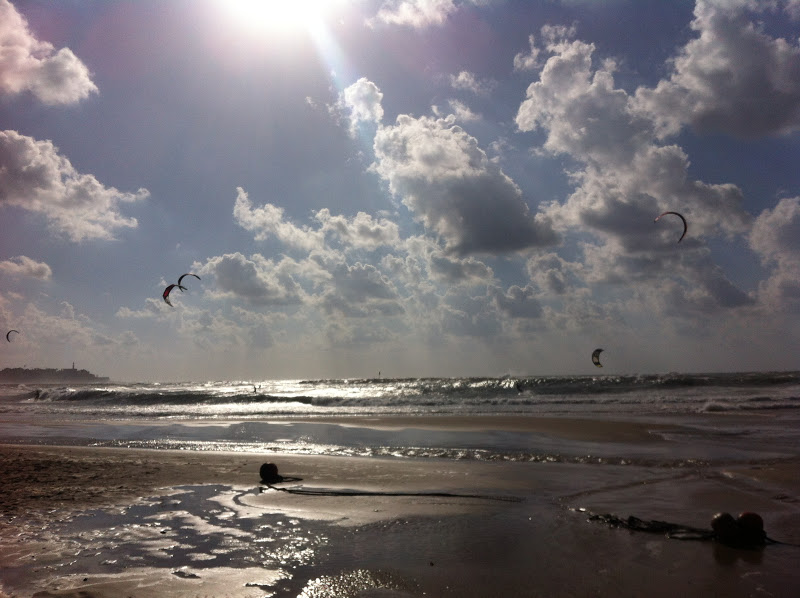
Last Friday I went with a group to Tel Aviv. It was a beautiful day. I didn't bring my swimsuit and regretted it deeply (but I just got in with my clothes anyway). The water was still SO WARM. 


 After hanging out at the beach we rented bikes and rode them alongside the beach. I have really missed riding bikes. I loved it.
Katie 


Amy riding by
 Then we walked around some interesting neighborhoods in Tel Aviv and saw some cool street art.


Bethlehem

Being at Herod's Herodian palace was eery. This man knew how to accomplish some incredible building projects and for this reason he was called Herod the Great. But everything about him personally was not great. His lifestyle was completely self-centered and deranged.

From Herod's palace it is possible to see Bethlehem.

"Then Herod, when he saw that he was mocked of the wise men, was exceeding wroth, and sent forth, and slew all the children that were in Bethlehem, and in all the coasts thereof, from two years old and under, according to the time which he had diligently inquired of the wise men." (Matt 2:16)

Historians estimate that around twenty babies from Bethlehem were murdered as a result of his command.

Despite Herod's efforts Christ was born in Bethlehem.

We spent over an hour waiting to get into the Church of the Nativity. Can't imagine how long it must take around Christmas time. Hundreds of pilgrims from all over the world waited in line with us. Just a reminder to me that Christ is for all people.

Seeing the grotto within the church where the birth of Christ traditionally took place was interesting but it did not aid me in imagining the humble, intimate setting in which the Savior came into the world.

The shepherd's field we went to after the church gave me more time to think and envision what Mary and Joseph may have seen as they came into Bethlehem.

Bethlehem is of a higher elevation than Jerusalem. The whole area is very mountainous or as one from Colorado would say "hilly". I had always imagined the angel declaring glad tidings of great joy to shepherds in a green pasture. Not the case. This land is brown, rocky and thorny.

The Herodian, one of Herod's palaces and his burial place

Quin attacking Staish in the tunnels used during the Jewish Revolt at the Herodian


outside the church (Liddy, Me, Mikelle, Mary)


waiting around the grotto

Mikelle and roommate Mckenzie touching the traditional spot where Christ was born.

Shepherd field in Bethlehem

Sunday, November 4, 2012

Yad Vashem

We had a field trip several weeks ago to the Israeli Holocaust Museum led by my Israel teacher Ophir Yarden. He gave us the Israeli perspective on the Holocaust. 

People who survived the Holocaust and came to Israel did not really talk about their experience. There were many reasons for this; survivor's guilt, too overwhelming, PTSD... but ultimately it was the judgmental nature of Israeli society that stopped people from talking. Imagine how often if one did talk about it phrases similar to "it was impossible to survive" and then the response "well then, how did you survive?" would come up. There was no pride in being a survivor. There was one group that did talk, the Warsaw Ghetto fighters. They led an uprising that lasted for three months against the Germans. If one had a heroic story to share then it was fine to talk. Otherwise you were expected to keep your mouth shut. 

The event that ultimately changed Israeli perspective was the 1972 Munich Olympics in which Israeli athletes were murdered by the Palestinian terrorist group Black September. The wrestlers who represented the strength and power of Israel did not struggle before they were killed. This allowed Israelis to start thinking that there is honor in the suffering and death of Jews in the Holocaust. 

Yad Vashem is the largest Holocaust museum in the world. There are ten different exhibition areas that tell the story of the Holocaust from a Jewish perspective. In the United States we tend to focus on the atrocities that occurred during the Holocaust. This museum discussed the events leading up to the Holocaust and the lasting results as well. 

Ophir Yarden

He has a skin disease that does not allow hair to grow on his body. At first it was a mystery as to how he managed to get his kippah to stay on his head. The answer; a form of double-sided sticky tape. 

Mt. Herzl

He wears a cap over his head to avoid the kippah tan 

Ophir Yarden is an amazing teacher. My friend Rachel says I have an intellectual crush. Perhaps this is true. I loved attending his class. I am sad they are over. His lectures were incredible. I would sit in class and he would present information and my brain would connect all the dots. He did not connect them for me, no that was the magic of it.
 Judaism is very different from Mormonism. At first it was difficult to grasp a concept that was so foreign. Yet Ophir's style of presenting information was perfect for the way I learn and I come away from his class feeling like I have a solid grasp on Judaism. Last friday night I attended synagogue with him and a group of other students. He is a wonderful example of a man trying to do his best to live his beliefs.  I am so grateful for all that I have learned from him. 


Friday, November 2, 2012

Border Crossing

The border crossing back into Israel took forever for various unimportant reasons. Some people in the group were stopped and questioned but I sailed through security with no issues. As I sat and waited for others to get through I noticed this charming young Arab family waiting for their bags to come through the security. The young Arab mother had three little boys. The youngest of which was no more than seven months old. I went up to her and in a mix of English and broken Arabic I started talking to her. She did not speak much English but she was extremely friendly. Then I turned to the baby and he played along perfectly. Immediately he smiled at me. Then he started laughing which in turn made his mother laugh. She would smile and laugh and say things in Arabic that I did not understand but I would smile and nod my head. She handed me her baby and let me play with him for a long time. She even left him alone with me while she went and used the bathroom.


I have felt a bit frustrated at times because I cannot communicate very well with the locals here since I do not speak Hebrew or Arabic. But this experience was a lesson to me in communication. Trust that forms from unspoken words.

Petra


I am sure my high school World History teacher Mr. Lindsey mentioned Petra. But I must have forgotten. Everyone knows about the Greeks and Romans but after seeing Petra I decided that the Nabateans deserve some more appreciation. The Nabateans had practically nothing but rocks out in the desert and they built this incredible city.

Here is my short history lesson:

The Nabatean people arrived in Petra around 400 BC, displacing the former inhabitants, the Edomites (Idumaeans).

Archaeological evidence reveals that the Nabateans rose to power due to their remarkable ability to control the limited water supply of their desert environment. They used water cisterns, dams and water conduits to create an artificial oasis.

They dominated Near Eastern trade for 600 years with their delicate eggshell-thin pottery and incense. They worshipped their gods through burning incense and animal sacrifices at open-air altars called high places or in temples. Elite Nabateans had the luck of being buried in rock cut tombs with carved facades. These facades have Persian and Egyptian influence. Greco-Roman influence is seen in later architecture.

We had roughly four hours to explore Petra on our own. I traveled around the site in a small group and we were able to see just about everything. I loved the scenic views, the friendly Bedouins, the camels and the freedom to wander around at my own pace. 

I had a really hard time picking through my photos. I took tons. Here is a sample.
Start off walking through a narrow canyon.

Then BOOM! All of a sudden "The Treasury" one of the most ornate facades in Petra, built as early as 100 BC. 


Camels and donkeys all over.


Bedouin women laying out their wares

amphitheater

tombs 

I am glad that we started early because the sun was hot, hot, hot


McKay making new friends

Bedouin girl


Bedouins live in tents woven with camel or goat hair

I was one of the first people to reach the monastery that morning. Really enjoyed the hike up to it.  

Tombs near monastery


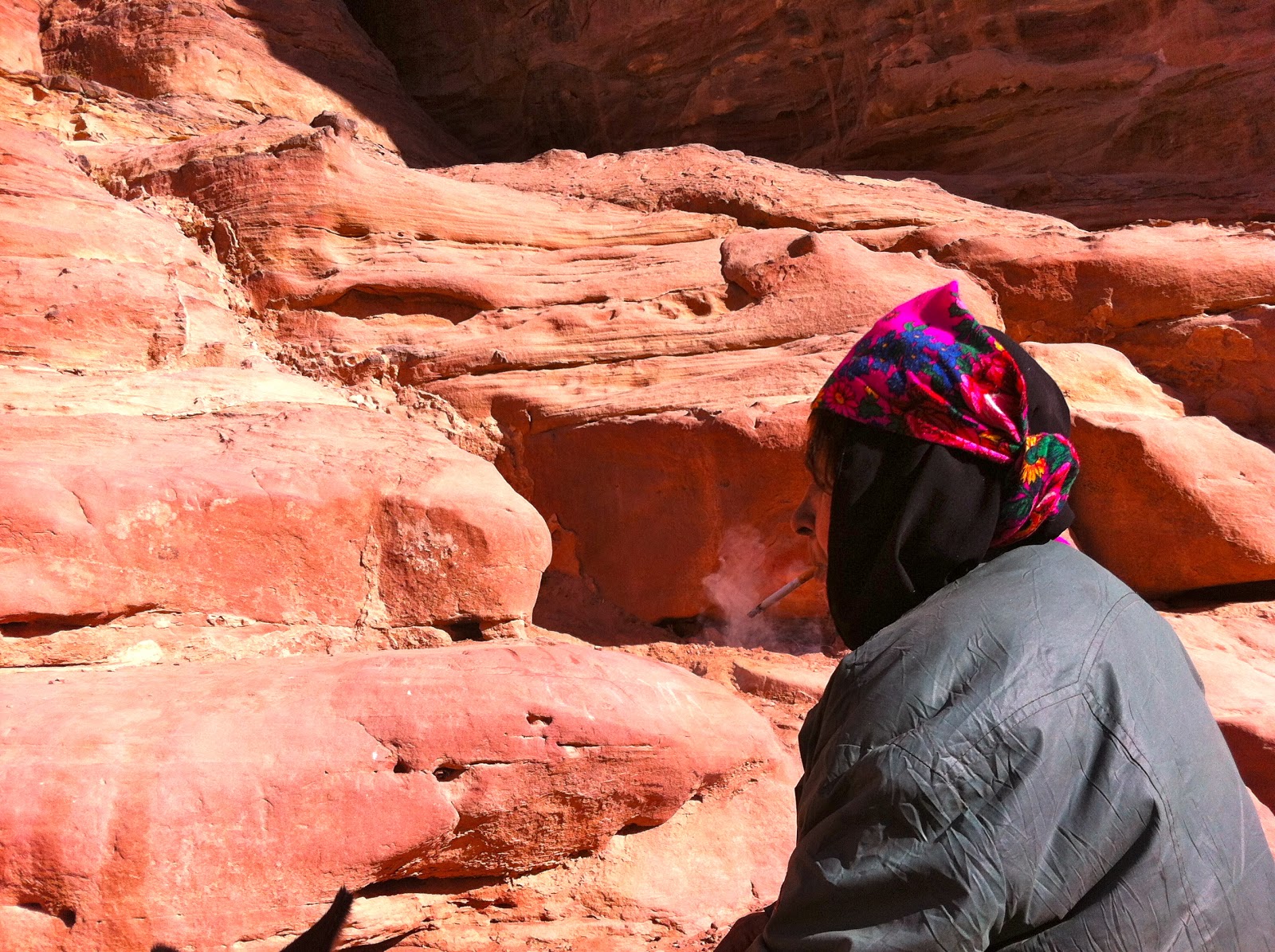
Bedouin woman 

Bedouin woman herding goats

Anna, Lily and Scarlett

The monastery was my favorite spot

working hard


we were invited to stop for tea many times


Bedouin family relaxing in the cool shade of a tomb


Liddy rode her donkey (Andrew) all the way up to the high place

Felt like a different planet at times

view from the "The High Place"

view from the "The High Place"

altar


Sometimes the sandstone is a rainbow of purples, blues, yellows, reds


inside a beautiful tomb


Bedouin family


tombs


I didn't think I would enjoy riding a camel this much. But I did. We all did. 

Liddy's feet afterwards

This was such an incredible experience. Definitely one of my favorite days thus far. I wish everyone could go to Petra. Especially Mr. Lindsey.